Genesis 4:1-17
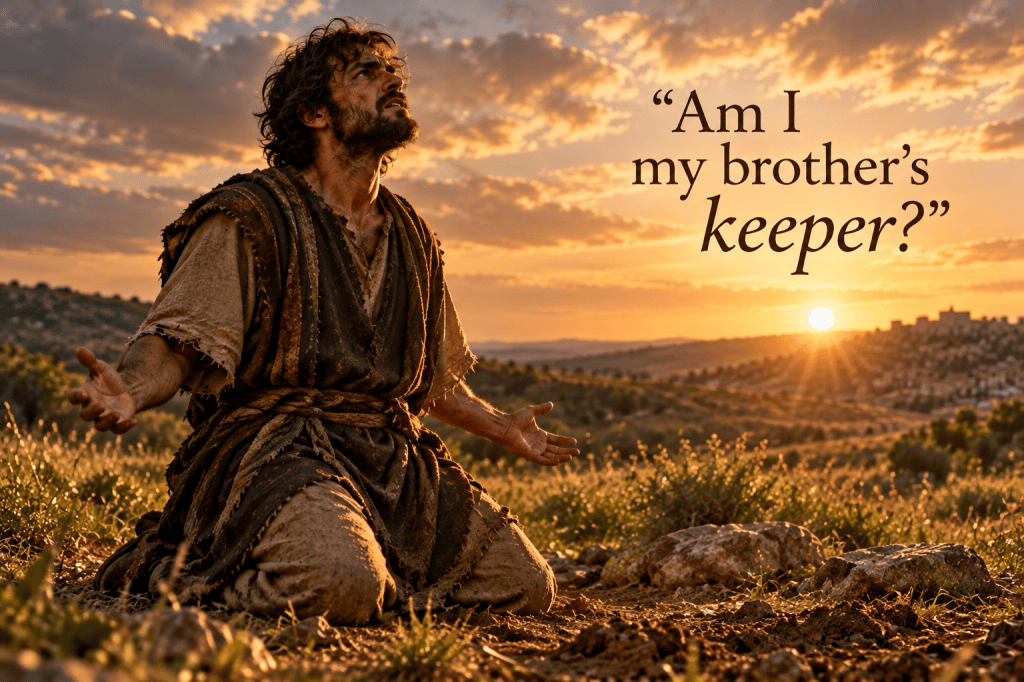
Image generated with the help of ChatGPT.
Never, on any given day, did I think I would want to sit at the table and talk about Cain.
Yes, that Cain. The one who murdered his brother Abel.
Not exactly the sort of fellow I’d normally invite over for coffee.
But here I am, cup in hand, wondering about a man whose story is among the earliest. A man who was sentenced to wander, yet somehow managed to build a city.
And I find myself asking: He built a city, but did he ever find his way back home?
I first met Cain in Genesis 4. The firstborn son of Adam and Eve, Cain was a farmer who tilled the ground. His brother Abel kept sheep.
Do you know this story?
Both brothers brought offerings to God. God looked favorably on Abel and his offering, but not on Cain and his.
Maybe God just has a preferred taste. Maybe Cain had a bad attitude. I don’t know. Scripture doesn’t tell us exactly why.
It does tell us that Cain became very angry. And God spoke to him. That’s the first thing that caught my attention when I went back to read his story. God saw Cain’s anger and spoke to him. He asked Cain why he was so angry and reminded him that if he did what was right, God would accept him.
But God also warned him. Sin was waiting for an opportunity to take hold of him, and Cain needed to master it before it mastered him.
Cain had a choice to make.
He made the wrong one.
Cain didn’t control his anger; he let it rule him instead, and he killed his brother.
There is no way to soften that truth. Abel was dead, and nothing Cain did afterward could change what had happened.
When God asked Cain where his brother was, Cain responded with a question of his own.
“Am I my brother’s keeper?”
That question has always troubled me, and I think I know why. Abel was a keeper of sheep. Cain wasn’t Abel’s keeper. He was something more. He was Abel’s brother.
I wonder whether Cain ever understood the difference. Scripture doesn’t tell us what Cain was thinking. But it does tell us how God responded.
God confronted Cain with what he had done. He said Abel’s blood cried out from the ground, and God heard it. Now Cain could no longer work the soil as he once had. The ground would not yield its strength to him, and he would become a wanderer.
Having grown up on a farm, I imagine losing the ground that had provided his livelihood must have been devastating. Cain lost more than his work. He lost something that helped define him, at least in others’ eyes.
I’ve noticed how often we identify people by the work they do. I know what that’s like. When I worked in a factory, that was part of how people saw me. It wasn’t all I was, but it was what they saw on the surface.
Cain was a farmer. But when he could no longer farm as he once had, what would he become?
And Cain feared that anyone who found him would kill him. And God marked Cain to protect him from anyone seeking to kill him.
Think about that for a moment.
God’s mark wasn’t punishment. It was mercy.
The man who killed his brother was afraid of being killed himself, and God intervened to protect him.
I wonder, did Cain understand? Did he recognize the compassion behind God’s warning before the murder? Did he understand the mercy behind God’s protection afterward?
I also wonder whether God would have warned Cain if God had no concern for him. Would God have protected Cain if there were no compassion?
Those questions stay with me as I contemplate Cain’s story.
God did not overlook Abel’s death. God held Cain accountable for what he had done. But neither did God abandon Cain. Both judgment and mercy were present, and Cain was allowed to live.
He went away from the Lord’s presence and settled in the land of Nod, east of Eden. He had a wife, became a father, and built a city that he named after his son, Enoch.
Built a city?
And now I have to pause again.
Cain could no longer be the farmer he had been. But he found another way to use his hands. He stopped wandering long enough to build something.
The more I think about Cain’s city, the more questions I have. So, I did some research. I spent some time exploring what biblical commentators have said about this part of his story. Their interpretations differ. Some see Cain’s city as an attempt to find security. Others wonder whether he was trying to establish something for his family.
I found their thoughts interesting, but they did not answer my questions.
God had told Cain he would be a wanderer. Yet here he was, building a city.
How does a wanderer build a city?
And why didn’t God stop him?
And then there’s the name.
Cain named the city after his son, Enoch. Names mattered in biblical times, and Enoch’s name is associated with dedication.
Was Cain dedicating something to his son’s future?
Did he want to leave something behind that would outlast him?
Did he hope his son would have a different life?
Was Cain discovering another purpose for his life?
Or was there something else behind his decision to build a city?
Questions, questions, questions! And again, Scripture doesn’t tell us.
But it does tell us that Cain built a city. And perhaps that’s something worth holding onto.
God could have stopped Cain from building that city. But he didn’t.
God provided protection for Cain’s life. He didn’t remove the consequences of Cain’s terrible choice, but now he allows Cain to build a future. And I would say that Cain didn’t waste the life he’d been given.
Still, building a city doesn’t necessarily mean Cain became a good man, nor could it undo what happened in that field.
It could not bring Abel back.
It could not restore the life Cain had known before his brother’s death.
And it could not, by itself, tell us whether Cain ever went back home.
I’ve learned something about that over the years.
We can acknowledge our wrongdoing. We can repent. We can make amends when doing so will not cause further harm. We can learn from our mistakes and choose to live differently.
Imagine if Cain had listened to God in the first place. If he had controlled his anger instead of allowing it to rage out of control. Abel might have lived, and Cain might never have become a wanderer.
But we cannot turn back the clock.
What has been done cannot be undone.
And experience has taught me that even if you can go back, you can’t always go home.
People change. Places change. And sometimes the home we remember no longer exists.
Perhaps finding our way home doesn’t always mean returning to where we began.
Sometimes it means accepting responsibility for the past and allowing God’s grace to lead us toward a different future.
Maybe Cain discovered that, after all he built a city.
I wish I knew.
I worry about the Cains of this world. The people who have made terrible choices. The people who have hurt others, broken trust, or caused harm they cannot undo.
Some may still be angry. Some may refuse to acknowledge what they’ve done. Others may carry guilt so heavy that they cannot imagine ever being forgiven.
And I find myself wondering: Do they know that this doesn’t have to be the end of their story?
Do they know that being held accountable doesn’t mean God has stopped loving them?
Do they understand that mercy doesn’t erase responsibility, but it can make a different future possible?
I don’t ask these questions because I believe wrongdoing should be excused. It shouldn’t.
Abel mattered.
His life mattered.
His death mattered.
God heard his blood crying out from the ground.
But Cain mattered too.
I think of the mark.
In the Methodist tradition, we speak of prevenient grace, God’s grace already at work in our lives before we even recognize God’s presence.
I like to think that, in a way, that grace has already marked us. Not with a visible sign, but with the assurance that God has not given up on us.
God is reaching toward us, waiting for us to turn and recognize the One who has been there all along.
God gave us the gift of free will.
This is what I am learning from Cain’s story.
God warned Cain about his anger. God told him that sin was waiting to master him. But God didn’t choose for Cain.
Cain chose, and his choice brought death.
That gift of free will carries an enormous responsibility. Our choices can bring life or destruction. Sometimes the consequences reach far beyond anything we imagined.
So, what can we do when we’ve already made the wrong choice?
What happens when the harm is done, and there’s no way to take it back?
I believe we need to turn to the God of second chances and accept his grace.
God’s mercy didn’t undo Abel’s death. It didn’t remove Cain’s responsibility. But it allowed Cain’s life to continue.
He still had choices to make. He chose to make a family. He chose to build a city.
Our worst choice doesn’t have to be our last. It doesn’t get to define us.
My worst choice didn’t stop me from living. The choices I made could have made me a very different person. But somewhere along the way, I began listening to the God of second chances.
I know Jesus Christ, and through him I’ve come to understand that forgiveness and a new beginning are possible. God’s grace doesn’t erase our past, but it can change the direction of our lives.
And perhaps that’s what I’ve been searching for in Cain’s story all along.
Not proof that he became a different man.
Scripture doesn’t give us that.
Not an excuse for what he did.
There isn’t one.
But proof that life didn’t end with Cain’s worst choice.
He was given more life to live. And he did something with it. He built a city and named it after his son.
Sitting with Cain at the kitchen table today has shown me that I serve a God of second chances. Even after our worst choice, there’s still time. Cain built a city with the life he was given.
We have a life to build, too.
What will we build, and who will we build it for?
“But as for me and my household, we will serve the LORD.” Joshua 24:15 (NIV)
Cathy D.


Leave a Reply