“Sir, let it alone this year also, until I dig around it and put on manure.” Luke 13:8 (ESV)
A few years ago, at a training event for clergy and church leaders, we were given an unusual assignment. Each group received uncooked spaghetti, tape, string, and marshmallows and was told to build the tallest tower possible.
Then the presenter told us something surprising: kindergarteners often outperform adults in this exercise.
Why?
Because adults spend most of their time planning and protecting themselves from failure. Kindergarteners simply start building. If the tower falls, they laugh, adjust, and try again. They are not embarrassed if their tower collapses. For them, experimentation is a natural part of the process.
Somewhere along the way, many of us lose that freedom. The truth is that fear of failure can slowly rob us of courage until we stop building altogether. We begin to see failure as a verdict instead of a teacher. We treat disappointment as proof that we should quit trying. We carry mistakes, griefs, embarrassments, and regrets as though they are nothing but dead weight.
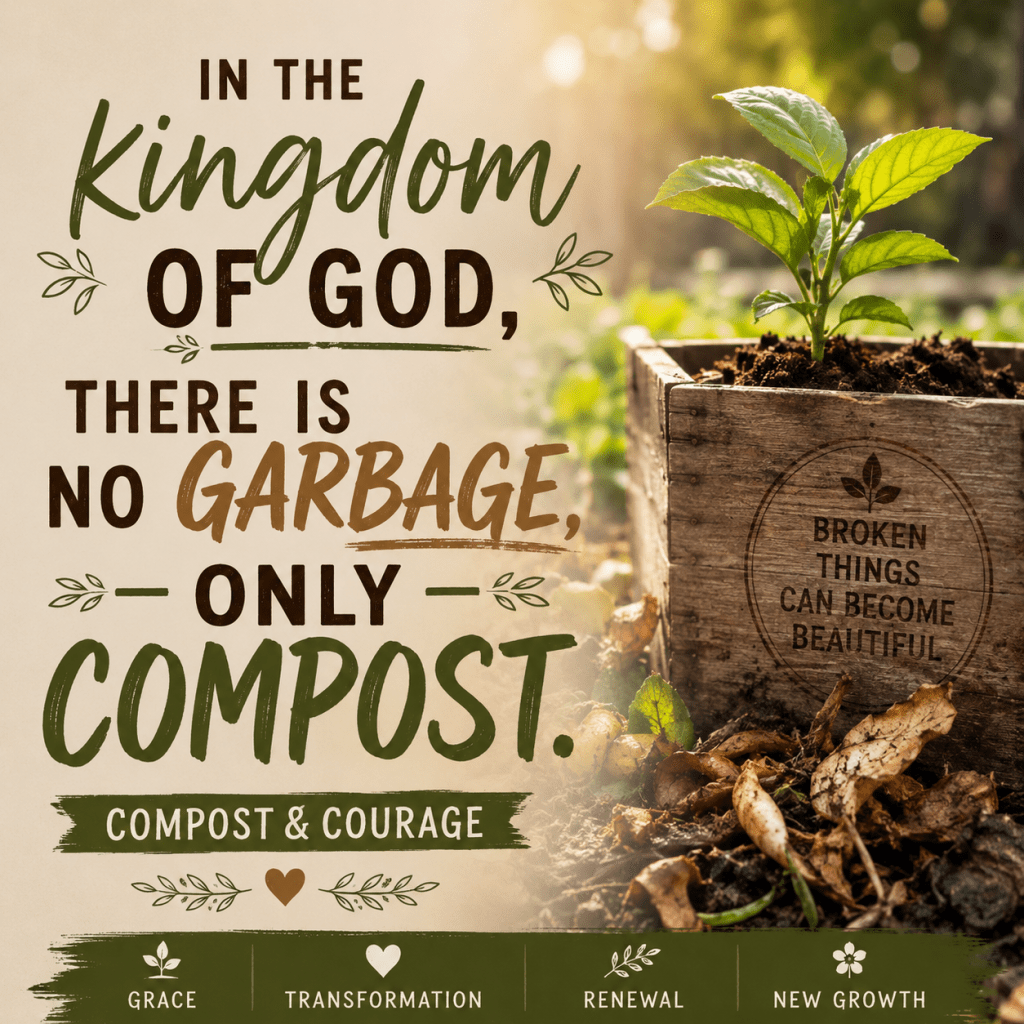
But gardeners know something we often forget—dead things are not useless. In the natural world, there is no garbage, only compost.
Years ago, a friend told me the secret of her beautiful garden. When plants began to die, she said, she threw them on the compost heap. What looked finished was not finished. What seemed ruined was being changed. In time, what had withered would become nourishment for new growth.
Being a farm girl, gardening has always been part of my life. And with her words echoing in my mind, I began to notice the similarities between growing green things and growing a spiritual life, and something clicked for me. Jesus’ farming parables suddenly felt less like illustrations and more like truth I could touch with my hands.
I have come to believe the soul works the same way as the natural world. The losses we grieve, the failures we regret, the seasons when nothing seems to flourish — even the parts of ourselves we would rather hide — can all be composted. Not denied. Not excused. Not erased. Transformed.
Just as compost transforms dead leaves into nourishing soil, our losses and mistakes can be transformed into spiritual growth. When we allow God to work through our failures, they become the foundation for new strength and renewal.
In the kingdom of God, there is no garbage, only compost.
In God’s hands, even what stinks at first can become the rich soil from which wisdom, compassion, patience, and mercy grow.
This is what I hear in Jesus’ parable of the fig tree. The owner sees a tree that has produced nothing and is ready to give up on it. The gardener asks for time. He will loosen the soil, tend the roots, and add what is needed. He knows that barren is not the same thing as dead, and that fruit often comes slowly.
Most of us know what it is to feel like that fig tree — behind, depleted, out of place, or ashamed that we are not producing what we hoped. We look at the strong, flourishing people around us and wonder what is wrong with us. But the good news of this parable is that God does not walk away from barren seasons. The Master Gardener tends what others might cut down.
Thinking of those kindergartners, I see a resilient faith that keeps building despite setbacks. Faith asks us to persevere, trusting that growth continues even after failure.
When life hands us failure, grief, shame, or disappointment, we are tempted to call it garbage. The gospel invites us to see it differently. Put it on the compost heap. Let God work with it. Let time and grace break it down into something that can feed new life. There is no waste in the spiritual life when it is surrendered to God.
If today you feel as though your plans have collapsed, or your life is not bearing the fruit you hoped for, do not despair. The Gardener is still at work. What feels like an ending may only be the beginning of a transformation. Keep building. Keep trusting. Give God the broken pieces, and trust that, in time, they may yet become the soil for something beautiful.
Cathy D.


Leave a Reply