A reflection of love and shared spaces.
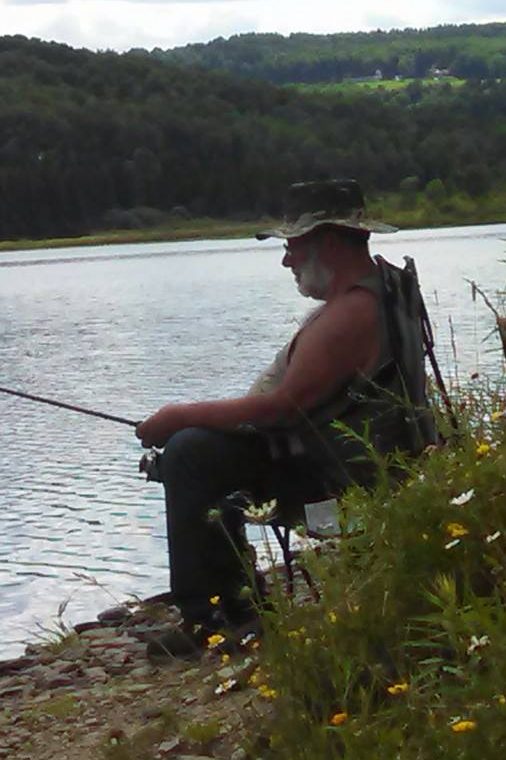
My husband at Beechwood Lake — the companion who loved the quiet as much as I did.
There is something about being outdoors — beneath an open sky, under a canopy of trees, walking beside small streams that grow into rivers, lakes, and finally the ocean’s edge — that revives something in me. It’s as if I carry an internal battery that can only fully charge when I’m near water, wind, and wild places.
My grandfather once told me that the outdoors was his church, the place he felt closest to God. Maybe some of that rubbed off on me. Or maybe it was a truth that sank in quietly over the years. Because I feel closest to God there, too — in the hush of the woods, in the shimmer of a lake, in the steady rhythm of water moving toward somewhere larger than itself.
Long before we were married, my husband joined me and my family at Hyner Run State Park for the first weekend of trout season. It was cold and muddy, the kind of morning when breath hangs in the air and the stream runs clear and fast. He wasn’t raised in this world of early‑morning casting and quiet patience, but he stepped into it with curiosity and a willingness to belong. He laughed with my family, learned the rhythm of the water, and settled into the silence beside me as if he had always known how. Watching him that weekend — shoulder to shoulder with the people who shaped me — I knew he was a man I could pour my love into. Even then, before vows and years and shared burdens, he understood something essential about me: that the water was where I breathed easiest.
We honeymooned in Florida, walking the shoreline in long stretches of quiet companionship, letting the waves speak the words we didn’t need to say. Years later — our fifteenth anniversary, if I’m remembering right — we found ourselves once again celebrating near the water, this time at a friend’s beach house in South Carolina. It felt fitting, almost inevitable, that we would return to the shoreline. We walked the beach in that same easy rhythm we’d found on our honeymoon: long stretches of silence, the kind that isn’t empty but full of trust and companionship. By then we had lived a lot of life together — joys, losses, ministry, family, the ordinary and the holy all woven through our days. Looking back, I can see how the water kept calling us back, marking the milestones of our life together. It was as if the shoreline itself bore witness to our love — steady, patient, and shaped by tides we didn’t always understand but always felt.
Maybe that’s why, when the Conference appointed me to a charge in North Central Pennsylvania, I felt a spark of excitement. There were lakes and streams to explore, and we were not far from Wellsboro and the Pennsylvania Grand Canyon. It was a small town I could walk easily, a place where neighbors waved from porches and everyone knew where the pastor lived.
And that mattered, because pastors carry more than most people ever see.
We carry our own lives — our families, our worries, our exhaustion — but we also carry the weight of everyone else’s. The deaths. The broken relationships. The diagnoses. The emergencies. The quiet suffering people bring to our doors. What our people experience, we experience with them, and sometimes for them. It is holy work, but it is heavy work.
Serving in that small town, even with two other churches nearby, it often felt like I had become the community pastor. My office was in the community center, and people knew me. They knew where to find me — down the street, next door, or walking to the post office. Whenever there was a need, they came. And I rarely said no.
My husband handled it all with more grace than I sometimes realized. He loved visitors, loved conversation, loved the small‑town rhythm of people stopping by. But he also saw the strain their needs put on me. He saw the way I carried every story, every crisis, every heartbreak long after the door closed. And while he understood the calling, he also felt the interruption — the way our life together was constantly threaded with other people’s emergencies. His irritation wasn’t with them; it was with the weight he watched me shoulder day after day. In his own way, he was trying to protect the part of me that rarely rested.
Finding a true “day off” wasn’t always simple. But we found a way.
We went fishing.
I’d post a message on Facebook: Gone fishing! Then I’d call my secretary and let her know where we were — just in case of a real emergency. We packed up the dog, our fishing gear, camp chairs, and a small cooler with drinks and snacks or a picnic lunch. And off we’d go.
Our favorite spot was a small lake called Beechwood. No motorboats — just kayaks and little boats with electric motors. Ospreys nested nearby, and the water always seemed to hold its breath in a way that made you whisper without knowing why.
Sometimes, before we even cast a line, we’d walk the shoreline and do a little cleanup. You could always tell who had been there before us. Outdoorsmen leave almost no trace — maybe a footprint, maybe a bent blade of grass. Visitors who don’t know how to belong to a place leave other evidence: bottles, tangled fishing line, snack wrappers, things that don’t grow from the earth and don’t return to it.
I was taught from an early age to leave as little of a footprint as possible — to clean up after myself and, if I could, leave creation a little better than I found it. So we picked up what others left behind. It felt like part of the ritual, part of the respect owed to a place that had given us so much.
Some days the beaver would come to check us out. And I don’t mean from a distance — I mean he would crawl right up onto the bank beside my chair as if conducting an inspection. Sally, our Jack Russell Terrier, would lose her mind, but the beaver never seemed impressed. He’d look us over, turn his back, lift that great paddle of a tail, and slap it on the ground with authority before slipping back into the water.
I always felt like he found us wanting — like we were trespassers on his lake. And honestly, he might have been right. Our fishing was never great after one of his visits. He’d swim slow circles around us, watching, supervising, making sure we didn’t get too comfortable. And when we finally packed up to leave, he would escort us along the shoreline, swimming beside us all the way to the parking area as if to say, “That’s right. Off you go now.”
It was hilarious. And holy. And humbling.
And then there were the bald eagles. A pair of them must have had a nest nearby, because if we were lucky, we’d see them circling overhead or swooping low to do a little fishing of their own. Their wings made a sound you could feel more than hear — a kind of authority in motion. We always kept Sally close on those days. She was only twenty pounds, feisty as anything, but we were never entirely convinced an eagle couldn’t carry her off if it wanted to. She had no idea she needed protecting, but we did.
My husband wasn’t the fisherman — I was — but he loved those quiet moments at the lakeshore as much as I did. He’d settle into his chair with a contented sigh, taking in the stillness, the birds, the way the light moved across the water. And even though he wasn’t raised with a rod in his hand, he became a little competitive with the fishing. We were strictly catch‑and‑release, and most of what we caught wasn’t big enough to keep anyway. But even the occasional bass or catfish, we’d admire for a moment before carefully placing it back into the water. He loved those afternoons, not because of the fish, but because he knew what the lake did for me. He saw how the weight I carried slipped off my shoulders, how the water steadied me. And in his own quiet way, he let the lake minister to both of us.
Between the beaver’s inspections, the eagles’ watchful passes, and the quiet work of tending the shoreline, it was clear we were guests in a world far older and wiser than we were. And somehow, that made the place feel even more sacred — a sanctuary not built by human hands, but shaped by water, wind, and creatures who knew exactly who they were.
If only my eyes could have recorded what they saw so I could play it back now.
Because that’s what I’m missing — the lake, the quiet, the companions who sat beside me, both now gone. I imagine them somewhere out there, beside another body of water, waiting for me.
I am thinking maybe it’s time.
Time to introduce more of my grandchildren to the fine art of finding their own lake or stream and dropping a line. To share with them the stories, the stillness, and the connection I found with the world around me and its great Creator.
The older I get, the more I understand that places like Beechwood are not just beautiful — they are sacred. They are sanctuaries that ask nothing of us except that we come as we are. They hold our weariness without judgment. They absorb the weight we carry as pastors, parents, neighbors, and human beings trying our best to show up for others.
And because these places tend to us so faithfully, we are called to tend to them in return.
Stewardship isn’t just about picking up trash or leaving no trace — though those things matter deeply. It’s about remembering that we belong to creation, not the other way around. It’s about honoring the lakes and forests and shorelines that heal us simply by being there. It’s about teaching our children and grandchildren how to walk gently, how to listen, how to notice, how to care.
These wild spaces restore us, inspire us, and remind us who we are.
And in caring for them — in protecting what is fragile and honoring what is ancient — we discover that we are also caring for our own souls.
When we moved to that little town, I didn’t expect to feel it — but I felt like I had come home. Not just to a community, but to a landscape that understood me. And the truth is, a little piece of me is still there. Maybe it always will be.
May you find the place where your soul breathes easiest — and return to it often.
Cathy D.
Dedication
For my husband —
my companion at the lakeshore,
my steady place in the world,
the one who saw the weight I carried
and loved me through it.
You sat beside me in the quiet,
you let the water heal us both,
and your presence made room
for my soul to breathe.
A part of me will always be
on that shoreline with you.
Benediction of Shared Love
May the God who shaped the waters
bless the love that shaped our lives.
May the quiet places we tended
keep the memory of our steps.
May the companionship we knew
rest now in the heart of the One
who holds all things.
And may the peace we found
by the lakeshore
lift like morning light
to meet me on the days I miss you most.
Amen.


Leave a Reply